
It’s been a while since I felt that I had something substantial to say on this since the podcast episode back in the gap, but this morning I had an insight during my meditation that I thought might help those of us that are struggling with this.
So here’s the secret to the third part of Bardon’s First Spirit training excercise: Taking the right lessons from the first two parts. I know that might sound a bit glib, but when I boil it down, that’s it. The three aren’t totally distinct excercises, but rather they are developing familiarity with various aspects of our mind, then gaining control of each aspect of it.
Let’s start with the first of the three parts, which I’ll refer to as thought observation here. The first thing we learn to do is to watch these thoughts as a separate mental process from our own mind, and that can be difficult to do. In part, it’s because our thoughts really only ever appear because our attention, the observer, is a key part of the thoughts appearing to us the way that they do.
Here’s where my morning meditation came in. I was there, just doing my thing when a thought happened. And not just happened, but I saw it happen in just the same way I remember seeing it for the first time. I saw it as a three part mental process.
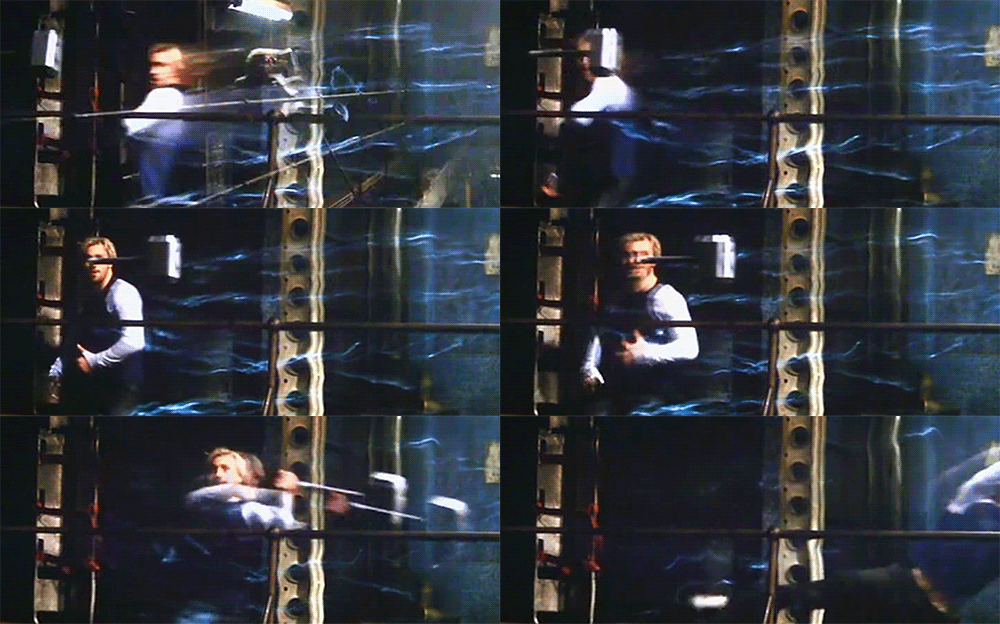
This may or may not reflect your own experience, but here’s how it appears to me: First, When I notice a full thought, it’s like a reverse echo that reaches coherence as the thought “articulates” itself to my conscious mind in the form of a sentence, or picture of whatever it is.

Behind this, or perhaps within this echo is a kind of mental movement or “thought-core comet” that streaks like a shooting star somewhere in the mental field. If you can catch this before the thought finishes articulating, you’ll notice two things:

1. The entire thought’s meaning is contained in it, but without the words. It’s an intuitive, experience based mental activity. Memories, imaginings, feelings make up the body of it. It’s our experiences coming together in new ways.
2. If you separate your attention from the streaking thought-core, the articulation echo fades away, and the entirety of the meaning comes through before the articulation vanishes all together.
Once we see that, the process of how these thoughts come to be becomes clear enough.
Movement occurs. Our attention follows & becomes absorbed in the movement. The meeting of these two produces the feedback “echo” by which the attention breaks down the movements into the mind’s preferred language, images, or whatever “form” it likes.
So from there… the process of choosing thoughts becomes as easy as peeling our attention away from the movement, and simply allowing the echo to fade, which is very quick actually.
(Another metaphor that comes to mind is to imagine sitting by a pond and watching the fish within. Its surface is still by nature, but then something underneath moves. It causes the surface to shift. This shifting draws our attention and we thrust our hand in to catch the creature.

This causes all sorts of ripples and disturbances, but we can usually draw out a fish. This the first step. If we watch instead to see what kind of fish it is, or even a specific fish, before deciding whether or not to go in after it is the second. To watch the pond without regard to the fish at all is third)

This is the heart of the second second part of the exercise, and just as the first shows us how to pursue the second, the second paves the way for the third.
We can learn to decipher whether or not a thought-core movement is in line with a chosen direction much faster when we are aware of the way they develop. Even the slightest attention to it will reveal its meaning long before the echoes allow for it to blossom into full articulation. In time, one gets a sense of how the similarities even in the feel of how they move that can tell you if they are related. The thoughts we choose to allow to articulate form links in a chain, threads that form a web. If we become familiar enough, with the movements, we can feel them coming from the same “direction” as if they are drawing from the same space.
We can then choose to ignore whole sections of our mental movements. We do this all the time, and that’s why Bardon has us doing this stage off of the meditation cushion. When we bring that level of awareness to our thinking, something else begins to reveal itself.
That something else is the empty space in the nature of the mental field. Those movements that we don’t allow our attention to grab onto just kind of gently roll, but then disappear. This produces a sense of space. By the time we’re isolating only one thought to be allowed full articulation, we’re almost completely enveloped in that space, and man, are we close to the much vaunted Vacancy of Mind.

In retrospect, it could definitely seem obvious that the space was always there. And it was. If we’re being honest, we all knew about it. What we didn’t know was how to inhabit it. How to dwell there consciously.
The problem is that we’re so habitually absorbed in constantly following those movements that we don’t even see them behind all the echoing articulation, let alone the infinite space of mind behind even those. For those of us that are “blessed” with being particularly quick witted, the problem might even be worse because we’re really damned good at the whole process. It’s a thing that’s become automatic, and ultimately it’s trapped us.
In fact, I suspect that a fair amount of those of that “can’t meditate” have a deep fear of the space. It’s not easy to face that the thing we have come to identify is really just illusion on thinnest surface level of our real mind.
Luckily, if we’ve been practicing the exercises, we’re becoming more comfortable in the empty space, more aware of it as an aspect of our being. If there is any kind of trick at all to the Vacancy of Mind here, any kind of technique, perhaps it’s that we simply allow all of the “thought-cores” to zip around without ever attaching our attention to them. It is totally absorbed in preserving the space.
There will still be movement in there. Those little cores will always move around, but what we learn is to not be bothered by them. At first, it’s like flowing with a gentle current, or floating underwater. With time, even that disappears into the total silence…. of the void.

 The Void Places of Spirit
Excellent, thank you! You put into words things I was struggling to define, and this makes me feel reassured that I’m in the right way 🙂
LikeLike
Glad to be a help!
LikeLike
This articulates a lot of what I have experienced! Great article!
Also based on your picture you wouldn’t happen to be a traveling man? Journeying west in search for that which was lost?
LikeLike
I am, from the west traveling to the east!
LikeLike
Oh fun! Very cool to find another brother using Bardon as a source of light!
Using my mirror to help me aim my gavel lolol. I have found IIH infinitely rewarding.
LikeLike
Good to meet you too Brother!
They’re both excellent branches of the Hermetic Tree and work well together!
LikeLike
Oh great! Yes this is really helpful confirmation of experience! Yes well worded. Thank you!!
LikeLike